Saturday, December 1, 2007

Singapore

I arrived in Singapore from Manila and secured a dorm bed in a great hostel for about US $14 per night. I had expected to meet Dave but I checked my email and discovered that he had suddenly delayed his trip overseas by one week in order to leave his work project in better shape. So Dave and I will meet in Kuala Lumpur, Malaysia, instead of Singapore.

Public transportation here is the best in the world. With a single card I can ride the subway or the bus and add money to my card at many locations. I found it so easy to get around that I ended up seeing many different parts of the city. Here is a picture of metro entrance near the city center:


Upon arrival I made a beeline for the Little India section of town. Indian food is my favorite and the few times I have tried it so far in the previous three months of my trip it has not been good at all. Well, that was about to change -- the Indian food is great here! I have been gorging myself nightly on it. I didn't mention this in my blog, but I was really losing weight after a couple of months of traveling. I think I may have lost as much as 4 kilograms (9 pounds). Part of the reason, I think, is that I don't snack as much between meals while on the road, I will sometimes miss meals due to traveling, and I am exerting myself with a lot of physical activity (primarily walking many kilometers everyday). So, about a month ago, I started stuffing myself silly at every opportunity and my weight seems to have stabilized. And it is so much fun! ;-) I have waiters ask if I am really sure about what I am ordering -- yes I am and I never leave food on my plate, either!

Here is a street scene from little India, about 14% of Singapore's population is Indian:


In this part of town, I mostly see only Indian men, not Indian women -- especially at night when no women seem to be out but there are hundreds of men milling about. I am not entirely sure why. I asked one of the locals but I could not really understand his response.

Here is the beautiful Clarke Quay area (unfortunately, the gorgeous night scenes did not photograph well on my camera):

I was having dinner down in this area one night and met Rego (on the left), an Indian who was raised by caucasian parents. He sings on the street for a living. We talked for a long time and he struck me as being a very sensible person. Later, we went down to where he sings, and he trains other people in his art (one is pictured on the right), also:


Singapore is a shopping mecca and the Orchard shopping area is where the most high end shops are located:
But these places were actually pretty expensive. For cheaper shopping I toured Mustafa's in downtown Little India. He is an Indian equivalent of Walmart's founder Sam Walton having come to Singapore with nothing and now fabulously rich by providing Singapore shoppers with great retail value.

I was at the Mustafa's money exchange (which is located outside, facing the street) to get Malaysian Ringits. There are several other money exchanges nearby. I looked and could not see one policeman or guard anywhere (in the Philippines there would have been half a dozen armed guards, at least). This is one of the safest cities in the world. There is less freedom here -- some restrictions on speech, gum was famously banned here until recently, smoking/eating/drinking on public transport is banned and subject to large fine, etc. But the system seems to have brought about a great deal of safety for local citizens. There are signs reminding people to: remain vigilant low crime does not mean no crime.

Singapore has been ruled by the same party (People's Action Party) since it gained full independence from Great Britain in 1959 and its first Prime Minister, Lee Kwan Yew, ruled for over 30 years and was Prime Minister until 1990 (his eldest son is now the country's third Prime Minister). Since Singapore declared independence from the Malaysian Federation in 1965, the standard of living has skyrocketed and Singapore has become a center of finance and education for Asia thanks largely to free market policies.

I was also amazed at how widely English is spoken in Singapore -- it is the official language in practice and I would say there is more English spoken here than in San Francisco. I thought that Mandarin and Malay would be more common but that is in fact not the case. In fact, when I visited the zoo and other places where I could observe families interact, I noticed that many parents, whose first language was obviously not English, spoke to their children only in English.

Here is a photo from the upstairs patio of my hostel. I really enjoyed staying in my hostel -- it was the first time on my trip I stayed in shared quarters and I may try that more often now. Hostels tend to have much nicer common areas than hotels and I meet a lot of interesting travelers there. Just before I snapped this photo the call to prayer went out for the mosque in the center of the picture. I love these gritty, colorful urban scenes and with the mosque in the center it is like a scene from the movie Syriana:

Some more pictures of the city center area:


I am really impressed by Singapore. They have the best public transportation, the best airport, the best zoo, the best botanical gardens, some of the best food, the cleanest city, they are trying to be America's most reliable ally, etc. As my friend, Surendra, told me, it is an underdog city trying to be the best in several things and I think they actually succeed.


Back to Manila for a week

Well, after that nice visit with Tom and Fhona and a one day stopover in Cebu City, it was time to fly back to Manila. There were plenty more sights to see on the big island of Luzon where Manila is located, but I never did get time since I spent most of the week with friends. Paolo showed me around some of the awesome malls in Manila.


In fact, Greenbelt Mall in Makati section of Manila is the most stylish mall I have ever seen -- the coffee culture is alive and well there! Paolo and I also took a trip to some mineral hot springs outside of town. Paolo even took me to a kickboxing match -- his friend owns the kickbox training gym. And he introduced me to some new Filipino foods. Since he is also a budding chef, he cooked me an Italian dinner, also. Thanks, Paolo!

I met several times with the friends that I had traveled with earlier. We seem to have a thing for cemeteries, so we visited the American Cemetery in Manila:


I was not sure where my Great Uncle Travis had died or was buried. He died in World War II in late 1944 and never got to see his son, Travis (after whom I was named). I did not see his name on the walls. We went to the office and got an official printout and found out he had died in France. However, Helen found her father-in-law's name on the wall. She had not known that his death was recorded here. She immediately called her ex-husband to let him know. Here she is pointing to the name:


The entire World War II campaign is explained by about 20 stone murals. The artwork and historical detail is quite amazing:


The Filipino people are quite thankful for America's sacrifices that led to their liberation from the Japanese after World War II. It is one of the reasons our countries continue to have such close ties today.

I did not take many photos during the times we went out but here is one of Helen, Liza, and Ara:


Later in the week we also went to a Karoake Comedy bar north of Manila. Basically, there are two men dressed as women on stage who crack jokes, sing, and require virtually everyone in the bar to come up and sing, too, at some point during the evening. This was far enough outside of the main part of Manila that they had apparently never gotten a regular tourist there before. So they spent about a third of the night making me the butt of their jokes, which was actually a lot of fun. Their routines were in Tagalog, but they would use English when joking about me ;-) I also sang three songs, something they required of me -- oh, the humanity! I am not sure if I have ever heard a worse rendition of "Hotel California," I think I will be getting some more practice back in the States. Karaoke is a big part of Filipino culture -- it is almost the default entertainment wherever you go, so be prepared!

I attended an Asian music contest very similar to American Idol. Wow, some of the singers were so good -- filipinos can really sing! Also, there were some distinctive Asian sounds that were really refreshing.
My new friend, Leah, and I also met through couchsurfing and after having lunch together she took me to a Chinese massage place in Chinatown. I had never had a proper massage as it just something that is not very common in America. Massage is definitely a part of the Filipino culture and is a common topic of conversation. Thanks, Leah!
Now I am off to Singapore to meet up with my friend Dave and begin our adventure together!

New Friends on Cebu Island, Malapascua Island

A friend of mine is a Christian missionary abroad. After I told him that I was visiting the Philippines, he mentioned that his father (Tom) had retired there and asked if I would be interested in meeting him. Tom and his wife, Fhona, live in the very north tip of Cebu Island, about a 5 hour bus ride north from Cebu City. I stayed with them in their beautiful home for several days and had a great time. Although they live in a small town, this is a more rural area and so I got to see the agricultural side of Filipino life. Tom and Fhona also gave me a lot of insights about Filipino life and culture. Fhona's extended family lives nearby. Before moving to the Philippines five years ago, Tom and Fhona lived in the States for 10 years.

On the first full day of my visit we roasted a pig at Tom's little beachhouse (which is a couple of kilometers from his house). I have some pig roasting experience and let me tell you, these guys know what they are doing! I met the extended family that day. Most of the family speak English, but many of them only know the basics, so anything beyond simple communication is not easy. It is not like in the city where most young people speak English quite well -- English is now the medium of school instruction for virtually all schools (public and private) in the Philippines. Many of Fhona's brothers and brothers-in-law have taken jobs abroad -- some of them as far as the Persian Gulf. This is common in the Philippines and can create strains on families when the mother or father or husband or wife is away for long periods of time. It is not an easy life.

On my last evening as Tom's guest, they finally relented and let me spend some money and so I took everyone out for a special dinner. Here is the extended family along with Tom (the caucasian) and Fhona is seated next to him (on the right when looking at this picture):


This is a picture of Vanesa and I. Vanesa is Fhona's niece. Wow, what a cutey!


During my visit at Tom's place, I took two days out to visit Malapascua Island on my own, which is a 30 minute ferry ride from there. I had a great time there! The island was gorgeous, probably the most beautiful scenery I have seen in the Phils. It is a tiny island known for diving and shallow coral reefs -- it is only about 1 kilometer wide and 2.5 kilometers long.

I hired a small boat to take me around the island snorkeling. I also explored the island on foot and walked through several villages (permanent population of about 4000 people) and met some locals while searching for the lighthouse on the island. I was having trouble getting to it, and so one of the locals helped me. Soon, we were joined by two curious little boys and finally by another teenager who could speak some English. They were showing me around including some things I would have missed on my own.

I was interested in a boat ride back to my hotel and I asked them how much -- they said they would take whatever I wanted to pay them. I said please tell me a price, so they said 100 pesos (about $2.40). I said I would pay them more, don't worry about it. They showed me several of the local sites. The boat owner, Toni, had lost a father to dynamite fishing. This used to be a common practice but is now illegal. Unfortunately, the practice of dynamiting has wrecked a lot of the corals around the island. Fhona's brother also lost a leg to this practice. Anyway, after showing me all around (there were a group of 5 of us now) and sitting down and talking and then taking me back in a boat right up to my hotel on the other side of the island, I paid them 300 pesos ($7), much more than they had asked for. This is a typical Filipino experience -- the people are kind and always willing to help. That amount of money is actually about 1.5 days wages -- there is a huge gap in income and wealth in the Philippines.

Also at Malapascua, the gorgeous(!) girls from my hotel invited me to the disco. There was some kind of fiesta on the island -- they could not explain to me exactly what was being celebrated, however. As part of the celebration, there were cockfights in the afternoon (a local took me as his guest) and then in the evening came the disco.

The girls had told me they would arrive at the disco about 10 PM, but I ended up arriving early at 8:00. The disco was basically an empty basketball court outside that was all lit up. When I started dancing, I was suddenly surrounded by about seven dancing transvestites. From where did they all come? They were fascinated with me and some of them were dancing uncomfortably close and in an alluring fashion. I started talking to one of them. He was only 17 years old! He said they were all there for a gay beauty pageant that was to take place in two days. OK, that explains it. He also said they like to pick up on foreign men. It turns out there is a big gay scene in the Philippines. I had no idea before arriving. Anyway, this is definitely not my cup of tea but they were friendly enough once I explained that I was not interested -- as always, I tried to maintain a good sense of humor throughout and that is the Filipino way! I also got to dance with the girls and we all had a nice evening.

After this last cockfight experience, I now realize that cockfighting is an insidious influence here. Many of the men sneak away from the family and lose a lot of money there. I have decided that I have attended my last cockfight.

I returned from Malapascua island to Tom's place for one final evening there. A typhoon came later to the area just as I was leaving Tom's place the following morning. The bus ride back to Cebu City took a long time and when I arrived it was dark and there were no taxis available because it was still raining. So I ended up walking from the Cebu City bus station to my hotel, about 3 kilometers (1.8 miles). Here is a picture of what was left of my umbrella, shown fully extended, which I promptly threw out. It had served its time . . . and I could only laugh about the whole situation! ;-)

I had a great time with Tom and Fhona and the extended family -- what great memories! They showed me unsurpassed hospitality and stimulating conversation. I hope that I get the chance to visit again.

Iloilo City and Cebu City

I visited Iloilo City which is located on the south of Panay Island. It is the second largest city in the central Philippines (also known as the Visayas) and has around 300,000 people. I definitely enjoyed this town although it is more of a nice place to live than a tourist destination. It is big enough to have lots of amenities but small enough to be easy to get around and there is not much pollution. I did not take many pictures, but you can see some pictures here taken by an American expat:

http://www.pbase.com/hammerslag/iloilo&page=3


Since I didn't meet anybody at Boracay island, I decided to finally give couchsurfing.com a try. This is a web site that allows you to register your profile and meet up with other travelers and hosts who live in particular cities. It is safer than randomly meeting people since people post information about themselves and get vouched for by other travelers and hosts. Anyway, I met Frank, who owns a local IT school, through couchsurfing and he showed me all around one evening. What a great host! Although he is Filipino, he used to live in the Bay Area, too, so we had a lot in common. Frank showed me all around the night life of the town and I could see how this place was small enough that you really could know a lot of the people that you ran across during an evening out. Frank invited me to a party at his house a couple of days later, but unfortunately my schedule required that I leave one day before that. I have discovered that Filipino hospitality is simply legendary.

I then visited Cebu City on Cebu Island. I think Cebu City has a population of around 2.5 million. It is a more manageable version of Manila with less pollution and traffic. Cebu City is where Magellan planted his cross when he "discovered" the Philippines for the West (he was killed not long after that) and also the location of the Spanish fort that was erected a few decades later when the Spaniards returned in force to take the islands. Anyway, I liked Cebu a lot more than Manila. I also think that this is where many of the foreign expats live -- I saw more of them here.

I am beginning to see that the malls in the Philippines are as nice or nicer than their counterparts in the USA. There is real mall culture here. And American franchises dominate everywhere. People like to hang out at the coffee shops -- the coffee culture seems to be as strong or stronger here than in America.

By the way, when I was in a taxi cab in Cebu City we passed a placed called "Big Bucks Cafe" with a logo amazingly like the Starbucks logo -- I asked and was told that the trademark laws are not as strong here. I did not get a chance to go back -- but I imagined a good photo would have been me sipping a latte and smiling at the camera in front of the "Big Bucks" logo. Well, I hope that just imagining it brings a smile to your face.

Well, I am only in Cebu City for a couple of days before heading to the northern tip of this island to meet Tom, an American expat, and his wife and her family.

Boracay Island, Philippines

The small island of Boracay is a world class beach resort and the most popular tourist destination in the Philippines. I ended up spending three full days (and four nights) there. I had my own cottage, bathroom, and small kitchen for the bargain price of about US $9.50 per day. Boracay has the kind of beaches that you would imagine for a wonderful tropical destination:


This beach (White Beach) stretches for perhaps 3 kilometers and behind the palm trees is a row of restaurants, bars, and stores the entire length. Also, motorized vehicles are forbidden in this section. All in all, Boracay is a wonderfully relaxing place.

Here is a flavor of travel in the Philippines. . . to get to Boracay from north Mindoro island I had to take a jeepney for about two hours to a larger town. The coastal road was astonishingly beautiful. Then I took a hired van that had stopped along the road to another town 3 hours further down the road from which I could take a ferry. Then I took the four hour ferry journey to Caticlan, which is at the tip of Panay Island. Then a short but somewhat treacherous 20 minute ferry ride to tiny Boracay Island, then a tricycle ride from the Boracay pier to my cottage. Yes, transportation can be an adventure here.

For the first time in my trip, I didn't really make any new friends in a place. I mostly spent the days alone on the beach and reading my new book on randomness and algorithms and their application to financial markets (OK, I needed a small break from fiction).

But I did feel "in the zone" here. By that, I mean a place where I am enjoying my time and not spending much money. I did a quick calculation on what I have spent on my trip so far, including all internal flights, immigration fees from before I left the USA, and my flight back to Singapore, and it is about $53 per day -- including my one-way flight to Hong Kong (reasonable since my trip is a little less than half over) it is about $61 per day. This includes all my SCUBA fees, too. I could have traveled much more cheaply (for instance, I have never stayed in dorms yet). That said, traveling in the Philippines is much more expensive than either Vietnam or China (or Malaysia or Thailand).

Tuesday, November 13, 2007

Diving again

It was sad to say goodbye to my new friends. But we agreed to meet up again when I return in a few weeks to Manila. So I took the ferry from Luzon island (where Manila is located) to Mindoro island. Here is a picture from the side of the ferry on my way. The scenery in the Phils is just gorgeous.


I ended up in Sabang, part of the Puerto Galera area in the north of Mindoro Island. Sabang is a beach town catering to divers with a population of around 20,000 people. I dived here for a few days, paying around US $25 per dive. It was a lot of fun. I got to explore coral reefs, steep dropoffs, shipwrecks, etc. Also, it was a great chance to polish some of my diving skills. What I had forgotten was a lot of the prep stuff before I get in the water -- once I am under the surface I am fine. But making these dives really helped me to hone my diving skills. And the diving sites were all near our beach -- basically within five minutes of leaving the beach on our boat we were underwater.


Toward the left side of this picture, if you look carefully, you will see a "floating bar" out in the water.

Barbeque at the Lake

The largest lake in the Philippines is nearby Pagsanjan Falls and called Laguna de Bay Lake. We actually had to increase elevation to go up to the lake, which is quite large, generally shallow, and has good water quality.

My friend knew about an old abandoned house on the lake and so we went up the day before to see if we would be able to use it for a grand barbecue. Here we are in our transportation for the lake reconnoitering mission:


Picture of a part of the lake itself:

We took a boat out to see the abandoned house and we found it! The owner mysteriously disappeared seven years ago. There is a caretaker on the small island who has his own place and takes care of this larger house. He also raises Talapia fish encased in nets about 60 meters offshore.


We found a farm that had a bunch of extra vegetables. We talked to one of the workers, and they said we could have all the veggies we want for 30 pesos (about US $0.70).


Here is the scene after he told us the price:


Well, the next day all of us went out to the abandoned place. My friends made a special Filipino vegetable paste out of the veggies we gathered and it was really good! I swam out and we netted some Talapia fish (we paid the caretaker). We barbecued the Talapia and they were so good! This was all polished off with some San Miguels, the national beer of the Philippines. I have never been much of a beer drinker but those San Miguel Lites are actually quite tasty!

It turns out that most Filipinos cannot swim, much to my surprise. I can swim like a fish, so I even gave a few swimming lessons for those willing to try. It was a great and relaxing day!

The Falls

After visiting the Tagaytay area, my friends and I went by bus, tricycle, and jeepeny to Pagasanjan Falls, located about 92 kilometers south of Manila. One the way I got to try a buko pie, which is a special coconut pie for which this area is famous. I don't like coconut in the USA, which is usually shredded, but it is different here -- chunky and apparently made from some special kind of small coconut. Well, it was great and I had an extra piece!

The Falls are famous here in the Phils, and many of the river scenes from the classic movie Apocalypse Now were filmed in this part of the river on the way up to the Falls:


Unfortunately, the bigger upper part of the Falls is closed this time of year, so we stopped at the smaller Falls downstream:


Some of us also opted for the special raft pull that takes you directly under the falling water. The water is coming down so hard that it can be a bit painful, but fun nevertheless!

Wednesday, November 7, 2007

Cockfights

My late uncle raised fighting cocks but I never got a chance to see a real cockfight since it is illegal in most of the USA. Most of the folks interested in this sport from the state where I come from, southern California, either go to certain parts of Arizona or Mexico for the fights (where they are legal). And most of them are Filipinos -- it is part of the culture. Even though I know this is a cruel sport, I have always wanted to see what it was like up close. Well, I finally got my chance!

On the way back from Taal Volcano we happened by chance upon a cockfighting ring that was holding fights. I had told my companions of my interest the day before. So three of us popped in for about 20 minutes to see what it was like. Until recently, women were not allowed inside, but this has now been changed. Actually, none of my Filipino friends had ever been to a cockfight, so they were also curious!

The way it works is that a sharpened blade is attached to at least one of the rooster's legs. Then they are both put in the ring together. What often happens is that they prance around for a few seconds, sometimes pretending not to even look at one another:


But then the feathers start flying when they attack:


What drives this sport is gambling. I think there was a fight about every 5 to 7 minutes, and you can see the frenzy of people placing their bets before the roosters are released in the ring:


I actually found this sport crueler than I had imagined. One rooster always dies and sometimes they both die. After each flurry of attacks, the roosters are reset in front of each other until one has made the other completely helpless (and bound for death). Even if the roosters can no longer stand, they will place them close to each other in hopes that one will regain strength to kill the other:
Here is a close up shot at some of the prize money offered for an upcoming day of cockfighting. There are around 43 pesos to the dollar, so one thousand pesos is equivalent to about 23 US dollars. The prizes range from a refrigerator down to 1500 pesos for the fastest kills. Also, notice that there is a 5000 peso prize ($115) for the *slowest* kill:

Well, I am glad I went for the experience, but I think this will be my last cockfight for awhile!

Tagaytay City and Taal Volcano

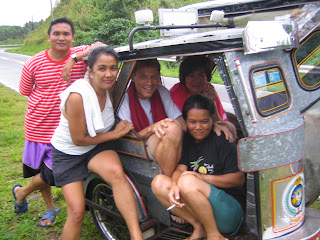
We all went to Tagaytay City (by combination of jeepney and tricycle), which is about 55 kilometers (35 miles) from Manila. Jeepneys are smoke belching trucks with a bench on each side in the back that provide transportation in the cities and shorter distances between many cities in the Philippines. The fares to ride the jeepenys are very cheap (typically less than 20 US cents for shorter distances) and you can stop them almost anywhere on the street as they are driving. You just look for a jeepney with a sticker for where you are going. Here is a typical Jeepney:


Tagaytay City is next to Taal Lake and in the center of the lake is Taal Volcano which has another lake inside it. It is quite spectacular!


We rode horses to the top of the volcano. Here is a picture of Aru (center) on her horse:


Here is a picture of Michelle and I with the lake inside the volcano in the background:


We had such a great time around Tagaytay eating local food and our place had a private picnic bench with a great view of the lake. I can't believe how friendly the Filipino people have been to me!

Meeting people in Manila

I was randomly walking along a tourist area of Manila (Intramuros) on my first full day in Manila when I ran into a grandma (Liza) and we started talking. She offered to show me another tourist site and taught me to ride the jeepneys. Liza wanted to invite me over for dinner but I already had a dinner commitment to a couple of nice Filipinas that I had met earlier and I had offered to take them out for dinner that evening. So Liza said let's meet at a certain location tomorrow.

Anyway, the dinner with the Filipinas went great (6 hours we stayed there!). The next day I met with Liza and her son came and then her sister-in-law. Little did I know that this was the start of a week long adventure with all the friends and family! We visited a local tourist site, the Chinese Cemetery (below), then went to a friend's place for lunch and then went to a karaoke restaurant/bar until late into the night (yes, they endured some of my singing!). I ended up staying at their place. The next morning they offered for me to join them on their vacation which was starting that day! So I retrieved my things back at my guesthouse and we headed for Tagaytay and the volcano there (more on that later).

The tourist site we saw in Manila was the Chinese cemetery. It is a large area of maybe 1 kilometer by 1 kilometer (at least) of what looks like houses or condos. But it is really a graveyard and the local rich Chinese people get buried there along with their familes. If you didn't know better, you might think it was a (very!) quiet suburban subdivision. Mostly there are just some security guards going around.

Here is a picture of one of the graves from the street (yes, there are streets just like a subdivision):


Here is a picture inside a typical "grave house" for lack of a better term:


Here is a picture down one of the "streets". For the most part, I saw only maintenance and security people during our visit (those are their cars in the picture):


Many of the "grave houses" are air-conditioned!

So is this elaborate burial rite only a Chinese practice in the Philippines? I have not seen anything like this elsewhere. What beliefs (Buddhism?) drive this behavior and why?

Tuesday, November 6, 2007

Loving the Philippines

I just wanted to post a quick update from the Philippines. I love this place! It is easily the most interesting place that I have visited so far.

I randomly met a grandma in Manila, and then her family and then their friends and spent a week with them on vacation. I have attended cockfights, sang karaoke, eaten Balut (cooked chicken embryo) and other local foods, gone diving at exotic destinations, and am currently staying at one of the world's best beach resorts, Boracay.

I hope to post more details and pics soon!

Wednesday, October 31, 2007

Crossing the road in Hanoi

My friend from the Netherlands, Daan, did this video of crossing a busy road in Hanoi, Vietnam. The key is to walk, don't run, so that the drivers can avoid you.


http://www.youtube.com/watch?v=VjGU8xtce6U


Most traffic in Vietnam is actually motorcycles, not cars. There was a free taxi ride included when I bought my train ticket through my Hanoi hotel. I have to admit that I was a little surprised when a motorcycle, and not a taxi, pulled up to take me to the station.

But after carefully observing Vietnamese traffic, my theory is that it is the most efficient system of transportation possible if human life is not a major consideration in your traffic model!

Sunday, October 21, 2007

Vietnam War

I did a tour of both the DMZ area in central Vietnam and the Cu Chi Tunnels 40 kilometers from Saigon in southern Vietnam. The Vietnamese people endured horrible hardship during the war of resistance against the French and then the Vietnam War (known as the American War here). Unfortunately, the official Vietnam displays and historical information is completely controlled by the government and it is so biased against Americans as to be cartoonish and completely lose what otherwise might have been an effective message. It is interesting that the French, Vietnam's colonial occupiers, were not really even mentioned that much.

The informational films in the exhibits were nothing less than propaganda. However, I was just a guest in the country and just tried to learn something without complaining.

The tourists from other Western countries all said the same thing about the cartoonish bias. Most of the exhibits are labeled something like this one, of which I happened to take a picture and the caption reads "The American soldiers panic at Lang Vay base. What's President Johnson thinking? "


The Vietcong lived secretly in the "Cu Chi" tunnels for many years just 40 kilometers from Saigon. The south Vietnamese knew they were in that area, but it took them years to figure out that they were living in tunnels during the daytime. They were very small and cramped and all dug by hand -- we got to squeeze through some of them. Cu Chi is a local tree that grows fruit that tastes sweet but is poisonous to humans.


You can also fire weapons at Cu Chi -- the Vietnamese are converted capitalists now and they have found this is a good way to make a buck. Naturally, I had to take a few shots with an American M-16 rifle (6 rounds for $6). I later found out that the ammunition used for the guns is left over from Vietnam War era stockpiles, meaning it is not really safe to use. But I had blast knocking off a few rounds!


Below are some of traps that the North Vietnamese "were forced to build" by the Americans. This first one, the green ball with long blades sticking out, would swing down from a tree:


This next one was buried in the ground. Once a leg was caught in it, it could not easily be removed -- trying to do so would embed the needles more. And the Vietcong used their human waste and other products to cause infection when the needles of any of these weapons penetrated flesh:


This one is the folding chair trap. Ouch:


One thing that I liked about the historical displays was that you could actually experience them. In a country like America, there would be too much liability to allow people to go into tunnels, to see any traps that were not in a glass display, or to fire M-16 rounds for fun.